Showing posts with label Vermont. Show all posts

Tuesday, October 5, 2010

Serendipity 3

A few weeks ago, Jeannine and I took a drive up to White River Junction, Vermont to visit the Center for Cartoon Studies (http://www.cartoonstudies.org/). James Sturm, author of several excellent graphic novels (including "Market Day" and "Satchel Page: Striking Out Jim Crow") created this school for comic book creators a few years ago and had invited us to come up and get a closer look at it.

It's quite an amazing place. Modest in size but bursting with ambition, it's the kind of school which I would have loved to attend in my younger days. We toured the main classroom building, which has a great basement studio filled with all the devices necessary to turn the art created by the students into actual printed books. And in another building, CCS has a wonderful reference library overflowing with just about every graphic novel and comics collection you could imagine.

But we started our tour with a short meeting in James' studio, and that's where the real subject of this blog entry begins. During our talk, James pulled out a large hardcover book featuring the work of a cartoonist I'd never heard of before, Denys Wortman, who'd produced many single-panel cartoons in the latter part of the first half of the twentieth century, mostly featuring urban settings and characters. The drawings were quite lovely, with a lot of painterly effects in the ink and crayon (Wortman did a lot of these drawings on coquille board). James also mentioned in passing that there was a connection between Wortman and the famous painter Thomas Hart Benton.

Fast-forward to the following week. Jeannine and I took a trip that I've been wanting to take for a while, since I'd found out that the New Britain Museum of American Art (in New Britain, CT -- website at http://www.nbmaa.org/), to which neither of us had ever been before, was having an extensive show of M.C.Escher prints and drawings.

So we drove down there, and decided to check out the entire museum (which didn't take too long -- it's not that big). I was surprised to see that one of the first galleries contained an exhibit of pulp magazine cover art, including a Virgil Finlay and a J. Allen St. John, among others. (I think this show is up through October of 2010.) We wandered around the galleries, admiring some wonderful landscapes by painters of the Hudson River School.

Then Jeannine stopped and nudged me. "I can't believe it!" she said. I looked at what she was looking at -- a painted portrait of Thomas Hart Benton by Denys Wortman!


And around the corner, in what you might call the museum's "Thomas Hart Benton Room", was a painted portrait of Denys Wortman by Thomas Hart Benton!


I mean, I'd never heard of this guy before we visited the Center for Cartoon Studies a few days earlier… and now this…!

Definitely one for the book of odd coincidences.

If you want to find out more about Denys Wortman, here's a nice site created by his son:

http://www.dwortman.com/about_denys.htm

By the way, the Escher show was great, and anyone who admires Escher's work should go to see it. I'd never seen an original Escher print, just reproductions in books and on posters -- I think I had at least one in college -- and they were beautiful. There were also some of the original wood blocks he used to do the woodcuts -- or were they wood engravings? One thing I'd never seen anywhere before was the assortment of preliminary sketches in pencil which Escher used to work out his intricate, mathematically complex images. And there were two very cool three-dimensional pieces, one carved from wood and the other made of sheet tin, which were based on some of Escher's tesselated images. -- PL

Tuesday, September 28, 2010

Serendipity 2

Back in 2008, I wrote about how Jeannine and I came across a vintage Japanese motorcycle show, completely by accident, while riding bicycles in Northampton's Look Park. I used the word "serendipity" to describe the experience, and noted it is defined by Merriam-Wedster's 11th Collegiate Dictionary as "the faculty or phenomenon of finding valuable or agreeable things not sought for".

On our trip to Vermont last week, we had two such experiences. One was the unexpected discovery of an A&W roadside drive-in restaurant, complete with young women on roller skates ("car hops", I think they're called) to bring your food order to your car, and set it on a tray hung on your partially rolled-up window. It was also a remarkable coincidence, as just the previous week I had been bemoaning to Jeannine the loss of these very places, and how I had not seen an A&W restaurant in at least the last five years.


(photo by Jeannine)

I had to pull over, of course, and even though it was mid-afternoon and I'd already had lunch, I ordered a hot dog and one of those wonderful root beers A&W is renowned for. The girl who took my order told us that this restaurant was the last of its type in New England.

But before that tasty discovery, we'd had an even more serendipitous experience. On the scenic drive up to Shelburne from Manchester, VT, we'd consulted a touristy map of the area and saw that there were two museums not too far off Route 7 -- the Maple Museum and the Marble Museum. (I later quipped to Jeannine that if there was a type of marble called "maple", that would be a real home run for Vermont.) She wasn't too interested in the Maple Museum, but the Marble Museum sounded kind of intriguing… and, as we were in no hurry, it was not a big deal to get off Route 7 in Rutland and head over on Route 3 to Proctor, VT.


There we found the Maple Museum, a large mill-type building with an imposing stack of marble blocks outside its doors.


Inside, there were many examples of things made from marble -- statuary, furniture, and the like -- and a room with large slabs of marble showing all the different types that Vermont is famous for.

Now here's the serendipity part: There was one room with displays geared mostly towards kids, explaining things like how the geological processes of the Earth produce marble and other rock. And in that room, on the floor behind a simple wooden rail, was this:


I don't recall all the details about this specimen, but I believe it is one of the few articulated (in this case meaning all of the bones were found together and in the proper arrangement) fossil skeletons of a Triceratops ever found. And here it is, on the floor of the Marble Museum in Proctor, VT!


It reminded me very much of another bit of fondly-remembered serendipity from those heady early days of dating Jeannine, when we'd made a plan to drive out to the Berkshire Museum in Pittsfield, MA. She'd read that an exhibit of masks was on display there and wanted to see them. Unfortunately, by the time we got there, that exhibit had moved on. Since we were already there, we decided we should walk through the museum (which, coincidentally, I'd never been in before, even though I'd lived my entire twenty-eight years at that time not more than an hour's drive away) and see what it had on display.

I walked around one corner and was stunned to see a juvenile Triceratops staring back at me. Or, to be more accurate, a model of a juvenile Triceratops… and right behind it, models of the same beast at earlier stages of its life. That would have been cool enough, but I was even more surprised to read the tags and learn that these were models made for use in an early 1960's adaptation for television of one of my all-time favorite books from my childhood, Oliver Butterworth's "The Enormous Egg". And these things had been in this museum pretty much for my entire life, and I'd never known about them. I was sorry that the mask exhibit that Jeannine wanted to see was no longer there, but I confess that finding those Triceratopses made that day for me.

Well, that, and spending some wonderful time with my lovely wife-to-be. -- PL

Friday, September 24, 2010

Vermont days

Jeannine and I took what I hope is the first of many "short vacation" trips this past week, driving up into Vermont and staying one night in Manchester and three nights in Shelburne. The main impetus for the trip was something we have talked about from time to time over the last twenty years or so, but for some reason just never got it together to actually DO -- and that was to make a return trip to the wonderful Shelburne Museum.

It was about twenty years ago that we got on my Gold Wing and headed north, accompanied by our friends Pat and Ed, also on their Gold Wing, for our first visit to the Shelburne Museum. I can't recall whose idea it was, but I am glad we went. The Museum is essentially one woman's somewhat eclectic collection of "Americana", encompassing a wide array of art and artifacts ranging from handmade quilts to carriages to glass canes to dolls to tools, and beyond. I think there are something like forty buildings on the site, and only few of them were built there, the others having been purchased and moved to the museum grounds. There is even a ship, a paddle-wheel steamer which used to ply the waters of Lake Champlain. In 1954 it was moved overland two miles to a permanent dry berth on land at the Museum site. Here's a shot of that ship, the Ticonderoga.


The Museum has a great deal of stuff to look at, and unlike the last time we were there, when we didn't, for some reason, take ANY photos, this time we took LOTS. (That first visit was before digital cameras, which partly explains the lack of photo taking.) One of the first things we saw was a new exhibit of quilts made by people who have had a loved one suffer from Alzheimer's. I was blown away by this one -- an impressionistic image of a ballerina.


Looking more closely, I was even more impressed to see how the artist had crafted the effect, using small swatches of different colored fabric, all careful sewn in just the right places.


I remembered that one thing I loved from our first visit was an old school sleigh -- not a bus with wheels, but a sleigh for use in the winter. It was small -- probably could only carry ten kids or so -- and actually had a small stove inside it for warmth! Clearly nothing that would pass safety regulations today.


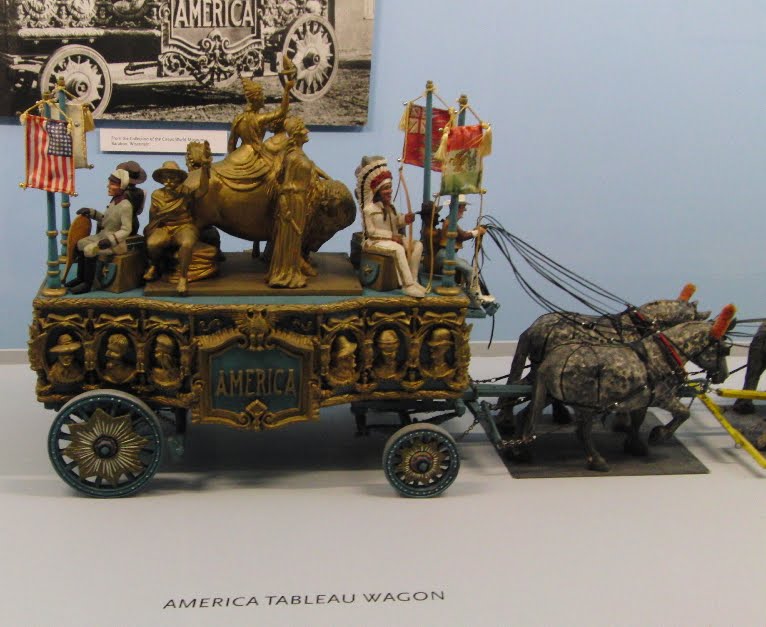
But the two things I really wanted to see again, and which did not fail to impress, much as they had done when we'd seen them the first time, were the circus and the circus parade. These exhibits are housed in a U-shaped building, with the circus taking up the first arm of the U. It is an amazing thing -- all hand-carved and painted over the course of forty years by a father for his children. The figures generally stand about four inches high, and it is a complete three-ring circus. It is an amazing sight. (That's Jeannine on the left in the first photo, having her mind boggled.)


Taking up the rest of the building is a circus parade, again all carved in wood, and the inspiration of one man (though he had some help with the work). Horse, camels, elephants, wagons, clowns, horses and riders -- they're all there, and beautifully, realistically rendered. I took over a hundred and thirty photos of the parade, and I think I got all of the pieces. Here are just a few of them.


For lodging, I managed to stumble across (in an online search) the Shelburne Farms Inn, originally the residence of the woman who started the collection that became the Shelburne Museum. It is quite the place -- right on Lake Champlain, with many acres around it of great natural beauty. There is a working farm on the property which provides the Inn's kitchen with some very fresh ingredients for their very yummy meals. (I managed to put on a couple of pounds while staying there for three days!)

Much like I did when we were in Maine this year, each day I tried to do a drawing, and I found some great rocks and dead trees down by the lake. I was fascinated by the strata exposed by erosion at lakeside. Here's a view from down by the lake, looking back towards the south end of the Inn. Our room looked out over this view.


There are a few more things about this trip that I want to post, but I'll do that tomorrow or the next day. -- PL